


Subbarama Dheekshithar
(composer, author)
 |
 Profile
Compositions
Related Composers
Articles |
Profile
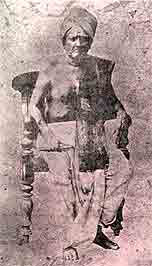
Subbarama Dheekshithar was the grandson of Baluswami Dikshitar, brother of Muthuswami Dikshitar. He was a great composer in his own right, but is more well known for Sangita Sampradaya Pradarshini, an important book detailing works of Muthuswami Dikshitar and a reference on many other Carnatic musical concepts.
Subbarama Dheekshithar was born to Annapurni and Sivarama Iyer. Annapurni was the daughter of Baluswami Dikshitar, brother of Muthuswami Dikshitar. Baluswami Dikshitar, a great musician, was at the court of Ettayapuram kings. He adopted Subbarama Dheekshithar as his own son and taught music to Subbarama Dheekshithar. Subbarama Dheekshithar began composing at the age of seventeen and became the ashtana vidhwan of the Ettayapuram kings at the age of nineteen. He composed maintaining the high style of Muttuswami Dikshitar, composing kriti-s, many varna-s, svarajati-s, and ragamalika-s. He also set to music, the Valli-Bharatam, a Tamil composition by Kadigai Namassivaya Pulavar of the Ettayapuram Court. "Ma moha lahiri" in Khamas on God Kumara at Kazhukumalai by the same Tamil scholar was also set to dance-music by Subbarama Dikshitar. He also did a Tamil translation of the Telugu Mahabharata.
Chinnaswami Mudaliar, a Superintendent at that time in the Madras Government Secretariat, was the first person to try to present Carnatic compositions using western notations. With the help of Shishyaparampara of Shri Thyagaraja, he gathered several hundred of Thyagaraja krithi-s and published the first issue of Oriental Music. Chinnaswami Mudaliar then started working on Muthuswami Dikshitar compositions which brought him to Subbarama Dheekshithar. Subbarama Dikshitar stayed with Chinnaswami Mudaliar for a considerable period of time and taught him intricacies of carnatic music. But due to failing eye sight he could not complete his work and requested Subbarama Dheekshithar to write a book on Muthuswami Dikshitar compositions.
Due to Chinnaswami Mudaliar's persistence and influence of Ettayapuram king, Subbarama Dheekshithar, by then over 60 years of age, worked on his magnamopus for four years. But before the book was printed Subbarama Dheekshithar died at a relatively young age of 67. His plans of publishing many compositions of Thyagaraja, Shyama Shastri and Kshetragna remained incomplete.
Sangita Sampradaya Pradarshini is printed in two vilumes and extends to about 1700 pages. It comprises 76 biographies of persons from Sarngadeva to those of Subbarama Dikshitar himself. Two sections are devoted to the science of music (Sangita-lakshana-prachina paddhati and Sangita-lakshana-sangraha). There is an exhaustive tabular statement of raga-s, raganga-s, upanga-s and bhashanga-s with their murcchana-s; a detailed descriptive guide in Telugu and Tamil to the gamaka-signs employed in the notations of the songs in the book and tala-signs. The main text of the work gives the 72 Mela-s and all their Janya-s with their raga-lakshana-s, explanation of their special characteristics, their lakshana-gita-s, sanchari-s and illustrative compositions; and supplements giving ragamalika-s and pieces of other composers who had lived in the previous three centuries, including 170 gita-s of Venkatamakhin, about 229 kriti-s of Muttuswami Dikshitar.
Related Composers
| Teachers & Influences | Baluswami Dikshitar (brother of Muthuswamy Dheekshithar) |
| Disciples & Followers | Ambi Dheekshithar (son) |
| Similar Composers | Pallavi Shesha Iyer, Maha Vaidhyanath Iyer, Patnam Subramania Iyer |
| Worked With | Chinnaswami Mudaliar |
| Musical Nirvana . com | Top | Last Updated on 27-Jun-2003 |