


Thyagaraja
(1767-1847)
 |
 Profile
Articles
Compositions  Music Samples |
Profile
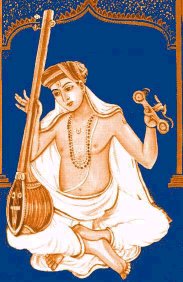
Thyaagaraaja is considered the greatest of the music trinity the other two being Shyama Shastri and Muthuswami Dheekshithar, his contemporaries.
He was born as the third child to Raamabrahmam and Seetamma in 1767 in the Telegu Vaidika family (Though there is a difference of opinion as regards the year of his birth. He was born on the fourth of May, the year being 1767 according to one tradition and 1759 according to another.) Thyagaraja was named after the presiding deity at the famous shrine at Tiruvarur and the name THYAGA-RAJA means the'Prince of Renunciation'.
He began his musical training in 1782 under Sonti VenkaTaraamanayya and learned a number of songs from his mother. During a span of eighty years he composed and sang hundreds of lyrics in praise of his beloved deity Lord Rama. Thyagaraja along with his great contemporaries Shyama Shastri, and Muthuswami Dikshitar, has enriched classical Camatic music. His spiritual attainments can be equaled only by his musical excellence.
The music of this greater composer is dedicated to the attainment of peace and happiness through sacrifice and renunciation. It is Bhakti Yoga at its highest. A remarkable feature of Thyagaraja's compositions is their poetic excellence and spiritual value. Thyagaraja's songs and his name spread far and wide during his own lifetime. A number of pupils came to him and he imparted to each a section of his compositions according to the student's voice quality and musical equipment. It is to these sishyas, we owe the propagation of the songs of the saint.
Thyagaraja's musical contribution is remarkable for its quantity and variety, as much for its quality. In his compositions there is a wide variety of form and type, from metrical compositions suggested by European band tunes, that were then familiarised at Tanjore, for example, 'Girirajasuta' and 'Raminchuvarevarura' to creations like 'Koluvaiyunnade', where sangatis are heaped and sahityas are moulded like pallavis. He takes his place among the musician saints of our country like Kabir and Purandaradasar, the latter having exerted a very large influence on him.
Some Incidents of His Performances
In 1802, he was invited to perform at his teacher's house before a select group of musicians he sang bilahari and then the kriti "Dorukuna ituvanTi."At another time, he sang at the request of his guru, beginning at 8 p.m. and finishing only at 4 a.m. Serfoji Maharaja heared of his performance and invited him to visit the temple to be rewarded, but Tyaagaraaja rejected the offer, singing "Nidhi caala sukhama?" in kalyaaNi, which means Does abundance of wealth bring happiness? The king realized his mistake and visited the saint-composer, who cured him of a stomachache.
In 1805 Tyaagaraaja lost an idol of Raama, thrown into the river Cauvery by his brother, but got it back after 3 months. When he lost the idol, he sang sadly "Endu daagi naado,"Where has He gone and hidden Himself?
Tyaagaraaja usually went from street to street singing and begging for rice. Once a sage named Haridas asked him to recite the name of Raama 960 million times. After doing so, Tyaagaraaja went to offer his prayer when he heard a knock on his door. Raama, Seeta, and Hanumaan were entering his prayer room and he was blessed to see the coronation of Raama. Moved with wonder and devotion, he sang "Baalakanagamaya" (the anupallavi of the kritis "Ela nee dayaraadhu" and "Bhavanuta").
In 1810 his daughter was married, and his disciple WalajapeTTai Vekataramana Bhaagavatar brought a picture of Raama, walking all the way from WalajapeTTai to Tiruvaiyaar. Tyagaraaja sang "Nannu paalimpa,"overwhelmed by this act.
Once he visited Tirupati, but when he went to the temple, it was closed. In sadness, he sang "Teratiyagaraadaa" and the temple officials gathered round in admiration when they saw the door opening by itself and the screen falling aside. He sang "VenkaTEsha ninu sEvimpa" in his happiness at seeing the Lord.
Tyaagaraaja's compositions include the Ghana Raaga Pancaratnam (5 gems) in raagams naattai, gowLa, aarabi, shreeraagam, and varaaLi, his most famous and scholarly contributions to Carnatic music, and he delighted in singing them. At the request of Kovoor Sundaram Mudaliaar, he sang the 5 kritis of the Kovar Pancaratnam. When he visited TiruvOTTiyoor at the request of his disciple Veenai Kuppayyar, he sang the TiruvOTTiyoor Pancaratnam. At the invitation of his disciple LaalguDi Raamayya, he composed the LaalguDi Pancaratnam. He also composed the Shreeranga Pancaratnam in praise of Ranganaata of Shreerangam and 5 kritis in praise of Sage Naarada. His numerous kritis include beautiful raagam, bhaavam and taaLam, with lovely lyrics,music, and devotion.
In 1847 Tyaagaraaja became a hermit, and on January 6, he died in the presence of his disciples. Two of his last pieces'Giripai' in Sahana and 'Paritapamu' in Manohari tell us that Sri Rama appeared before him and assured him of moksha within a few days. In accordance,the saint died on sixth January, 1847, when he was 88.
| Musical Nirvana . com | Top | Last Updated on 01-Jul-2000 |