


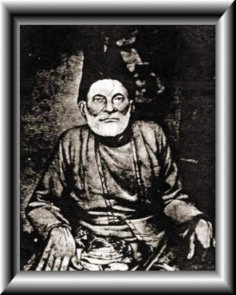
Mirza Ghalib
(1797-1869)
 |
 Profile
Ghazals
Links |
Profile
Mirza Asadullah Beg Khan -- known to posterity as Ghalib, a `nom de plume' he adopted in the tradition of all clasical Urdu poets, was born in the city of Agra, of parents with Turkish aristocratic ancestry, probably on December 27th, 1797.
When Ghalib was six years old, he lost his father, an army officer in the Alwar army, he had no financial resources to fall back on but depended wholly on his monthly pension of Rs 750 granted to him by the British government. The Mughal court that patronised literary and scholarly people ignored him. Much to his chagrin, his rival Mohammad Ibrahim Zauq was appointed King Bahadur Shah Zafar’s poetic perceptor. Ghalib sulked and suffered, but took it all as part of his life.
After his father’s death, Ghalib came to Delhi and lived there till his death. Initially, he started writing poetry in Urdu but thought it alien to his temperament. He preferred to write in Persian and composed Persian poetry in the manner of the poet Bedil who dabbled in recondite and curious matters. Ghalib thought highly of his Persian poetry but he felt that his Urdu poetry was bey-rang (colourless).
Ghalib’s literary rivals condemned his Persian poetry as intricate, obscure and elusive Ghalib wrote a great deal of Persian poetry and used literary form such as ghazal, ode and quatrain. It is a pity that his greatness as a Persian poet has been insufficiently recognised. In Persian poetry his range is wide, his use of metaphor austere, and he plunges us in the depth of human passions. Along with Amir Khusro and Faizi he ranks as one of the greatest of Persian poets in India.
Though his poetry is occasionally lit up with flashes of wit and humour, Ghalib, yet there was subtle of poignancy in his poetry. This is what is the driving force in his poetry. In fact, what Shelley wrote in a different context applies to him ‘Our sweetest songs are those that tell of saddest thoughts’. Ghalib does not present a single, coherent vision of life, and for that matter, no great poet ever does, not even the myriad – minded Shakespeare, the poet of all ages.
Endowed with the insight of understanding the vicissitudes of human nature and original sense of Persian and Urdu Languages, Ghalib produced poetry which expressed varied states of mind. Bahadur Shah Zafar commissioned Ghalib in 1850 to write the history of Timurids in Persian in two volumes, Mehr-i-Nimruz (the sum of noonday), and the second Mah-a-Nimruz (the full moon). Ghalib completed the first volume in August 1857, but the second volume never appeared. Ghalib’s historical work was superficial. He was not trained in the rigidity of historical discipline. Nor did he possess Maulvi Zakaullah’s patience of tracking down and compiling historical material. He set manner over matter, and thus wrote a fine literary work, but not history.
He had a free and independent mind, ever restless and impatient, to find new things and comment on them from altogether a new perspective. The following verse expresses his firm commitment to human values: Ham mahavad hain harmara kesh hai tarkey rasoom Millitayan jub mit gayeen juzwain eman ho gayeen (God is one – that is our faith. All rituals we abjure, It’s only when symbols vanish. That belief is pure.)
Ghalib was a prolific letter-writer. He wrote letters in a refreshingly light-hearted way on a variety of subjects. He adopted a conversational style in which conversation was direct and intimate. Ghalib’s letters laid the foundation of modern Urdu prose. Some of the letters evoke a painful memory of the 1857 events which overtook Delhi. He had witnessed the fate that befell Delhi. He was a broken man, and knew not what to do, and where to go. His letters express his anguish over the piteous spectacle of his compatriots who had felt compelled to flee from Delhi.
Ghalib remained perpetually in debt because he lived beyond his means. He was ever anxious to maintain a high standard of living commensurate with the reputation of his family background.
Ghalib stood at the crossroad of history – the old order was yielding place to new. He represented the finest human values of Mughal culture and yet was the harbinger of a new era. His age was too mediocre to supply the necessary intellectual and social stimulus to his creative genius but he made the best of it in the conditioning circumstance. His tone of voice remains marvelously distinctive and original and he still makes his appeal to the lovers of poetry all over the world. Here is one of my favourite ghazals rendered so well by Jagjit Singh.
bahut nikale mere armaa.N lekin phir bhii kam nikale
Ghazals
List of some of his popular ghazals
- aa, ki meree jaan ko qaraar naheeN hai
- aah ko chaahiye ik 'umr asar hone tak
- 'arz-e-niyaaz-e-ishq ke qaabil naheeN raha
- baazeechaa-e-atfaal hai duniya mere aage
- be-'eitadaaliyoN se, subuk sab meiN ham huve
- bus ki dushwaar hai har kaam ka aasaaN hona
- daayam paDa huaa tere dar par naheeN hooN maiN
- dard minnat_kash-e-dawa na huaa
- dekhna qismat ki aap apne pe rashk aajaaye hai
- dhota hooN jab maiN peene ko us seem_tan ke paaNv
- dil-e-naadaaN tujhe huaa kya hai ?
- dil hee to hai na sang-o-KHisht dard se bhar na aaye kyoN ?
- dil se teree nigaah jigar tak utar gayee
- diyaa hai dil agar usko, bashar hai kya kahiye ?
- fir kuchch is dil ko beqaraaree hai
- fir mujhe deeda-e-tar yaad aaya
- GHair leiN mehfil meiN bose jaam ke
- ghar jab bana liya hai tere dar par kahe baGHair
- hai bas ki har ik unke ishaare meiN nishaaN aur
- hairaaN hooN dil ko ro'ooN ki peetooN jigar ko maiN ?
- har ek baat pe kehte ho tum ke 'too kya hai' ?
- hazaaroN KHwahishaiN 'eisee ke har KHwahish pe dam nikle
- husn-e-mah, garche ba_haNgaam-e-kamaal achcha hai
- ibn-e-mariyam huwa kare koee
- ishq mujhko naheeN, wehshat hee sahee
- jaur se baaz aaye par baaz aayaiN kya ?
- jis bazm meiN too naaz se guftaar meiN aave
- kabhee nekee bhee uske jee meiN gar aa jaaye hai mujhse
- kisee ko de ke dil koee nawaa_sanj-e-fuGHaaN kyoN ho ?
- koee din gar zindagaanee aur hai
- koee ummeed bar naheeN aatee
- laazim tha ki dekho mera rasta koee din aur
- maze jahaan ke apnee nazar meiN KHaak naheeN
- meharbaaN ho ke bulaa lo mujhe chaaho jis waqt
- miltee hai KHoo-e-yaar se naar iltihaab meiN
- muddat huee hai yaar ko mehmaaN kiye hue
- na tha kuchch to KHuda tha, kuchch na hota to KHuda hota
- naqsh fariyaadee hai kiskee shoKHee-e-tehreer ka
- nuktaacheeN hai GHam-e-dil usko sunaaye na bane
- rone se aur ishq meiN be_baak ho gaye
- shauq har rang raqeeb-e-sar-o-saamaaN niklaa
- Taskin ko ham na roen jo zauq-e-nazr mile
- us bazm meiN mujhe naheeN bantee haya kiye
- woh aake KHwaab meiN taskeen-e-iztiraab to de
- woh firaaq aur woh wisaal kahaaN ?
- ye jo ham hijr meiN deewaar-o-dar ko dekhte haiN
- ye na thee hamaaree qismat ke wisaal-e-yaar hota
- zikr us pareewash kaa, aur phir bayaaN apnaa
- zulmat_kade meiN mere shab-e-GHam ka josh hai
Links
The web page will open in a new window
| Musical Nirvana . com | Top | Last Updated on 17-Jul-2000 |