


Ustad Zia Mohiuddin Dagar
(1929-1990)
 |
 Profile
Discography
Related Artists
Links |
Profile
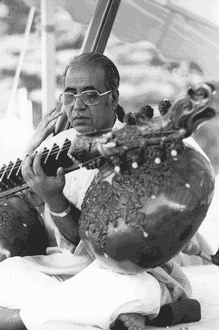
Ustad Zia Mohiuddin Dagar is known as the foremost exponent of Rudra Veena in the 20th century. He made significant modifications to the instrument which made it possible to bring it out as a modern solo concert instrument. He is popularly known as Z M Dagar.
Zia Mohiuddin was born on March 14th, 1929, in Udaipur, Rajasthan. His teacher and father was Ustad Ziauddin Khan Dagar, court musician for the Maharaj of Udaipur. Like all Dagars he was very well trained in vocals too. His younger brother Ustad Zia Fariduddin Dagar took up vocals as the primary medium. With the collapse of royal patronage after independence, all artists had to depend on public support for their livelyhood. Dhrupad artists were particularly badly hit, since dhrupad had started losing popularity. Thus, the story of all dhrupadiyas is one of struggle.
Zia Mohiuddin started experimenting with the construction of the veena to improve its acoustics. He modified and redesigned the veena in cooperation with Murari Mohan Adhikari, a instrument maker from Calcutta who was one of the last owners of the famous instrument workshop Kanailal & Brother. He used for his Been bigger gourds (Tumbar) and a thicker tube for the connecting instrument neck (Dhandhi). That made the use of stronger strings possible which together with the corresponding fine polish of the Javari produced the soft and deep sound of the Dagar Vina. Beside the needful change of the traditional playing posture Ustad Zia Mohiuddin Dagar also plucked the strings without the use of any plectrum (mizrab).
He captured the subtle unique character of each Raga often depends on accentuating the sharp ,flat or very flat qualities of certain notes; and it was the perfect rendering of these subtleties that became a Dagar trademark. In a deliberate and unhurried fashion , he unfolded and revealed each note of the Alap movement , the slow , serene solo exposition of Raga – hypnotically, hauntingly coaxing and stretching the most delicately shaded nuances , the notes between the notes, from the thick bronze strings. He represented the Serene, devotional, almost mystical style of playing that is the hallmark of all dagar bani. He had the ability to deeply move audiences, even laymen, with his meditative rendering of raaga-s.
With the revival of Dhrupad primarily because of the efforts of Senior Dagar Brothers and Zia Mohiuddin Dagar, demand for drupad started trickling in, esp. in the west. Ustad Zia Mohiuddin Dagar was instrumental in introducing US audiences to Rudra Veena when he was a US, as a visiting professor, at Wesleyan, University of Washington.
In 1988, Ustad Zia Mohiuddin Dagar started a Dhrupad Gurukul near Bombay at Palaspe, Panvel, where he wanted to impart his immense knowledge to young disciples. After his demise in 1990, the gurukul is run by his wife, Pramila Dagar and brother Fariduddin Dagar. His son Baha-ud-din Dagar is his musical heir as well, having learnt Rudra Veena from Zia Mohiuddin Dagar and then Fariduddin Dagar. Ustad Zia Mohiuddin Dagar received several awards during his life time including Sangeet Natak Academy Award , and the prestigious Kalidas Samman from Govt of MP.
Related Artists
| Teachers & Influences | Ustad Ziauddin Khan Dagar(father) |
| Disciples & Followers | Ustad Zia Fariduddin Dagar (brother), Baha-ud-din Dagar (son), Gundecha Brothers, Uday Bhawalkar |
| Similar Artists | Ustad Asad Ali Khan |
| Worked With | Sri Purushottam Das (pakhavaj), Pandit Shrikant Mishra (pakhavaj), Raja Chhatrapati Singh Ju Deo (pakhavaj) |
Links
The web page will open in a new window- North American Dhrupad Association
- Dagars at drupad.de
- Ustad Ziauddin Dagar Memorial Trust at dagar.org
- Dagars at dhrupad.org
| Musical Nirvana . com | Top | Last Updated on 12-May-2003 |