


Sarangi
(hindustani, string instrument)
 |
 Profile
Artists  Pt Ram Narayan |
Profile
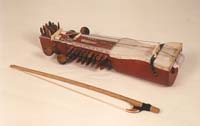
Regarded as one of the most ancient and difficult stringed instruments, Sarangi originated in North India. The name is derived from the word 'Saurangi', which means 'hundred-colored', describing its ability to convey a wide range of mood and emotion. There are as many as sixty variations of the instrument. The most advanced version, played by Pandit Ramesh Misra, is a hollowed piece of wood carved from a tree trunk. The resonator hole, where the strings are bowed, is covered with a piece of leather. It has three gut playing strings and no less than 36 steel sympathetic strings, all of which must be tuned according to the raag being played. The three playing strings are stopped with the cuticles of the left hand fingers, while the right hand bows at the bottom. Needless to say, intitial training of this instrument does require blood, sweat, and (sometimes) tears.Traditionally, Sarangi has been relegated to the role of accompaniment in vocal music, due to its brilliant sonorous quality. Unfortunately, the recent introduction of the Harmonium (akin to the accordian), along with Sarangi's own rigorous physical demands, has made the instrument an endangered species, and true masters have become difficult to find. Masters such as Pandit Ram Narayan, Ustad Sultan Khan, and Pandit Ramesh Misra have revived the status of Sarangi through unforgettably stirring and moving performances. The instrument can literally make one cry, smile, or hide.
Links
The web page will open in a new window
| Musical Nirvana . com | Top | Last Updated on 21-Feb-03 |