


Kamod
(hindustani raag)
 Profile
Discography
Hindi Film Songs
Links  Audio Sample - Kamod |
|
||||||||||||||||||||||||||||||||||||||||||||||||||||
Profile
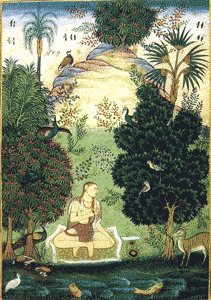
Kamod is an ancient raga and several varieties have been described in the literature of the past. Some believe Kamod is a mixture of Gaud and Hamir. In a mid-16th century treatise on music and several ragamala paintings it is portrayed as a semi-nude female ascetic with a rosary in her hand. Once a major raga which could supposedly cure the sick, Kamod is not often performed today.
This rather complex raga shows an abundant usage of glides and oblique passages. Re and Pa are important notes, and in ascent Re is usually approached from Ma, as in the distinctive Kamod movement M \ R / P. Sharp Ma is used only in association with Pa and Dha. Ni is a weak note and Ga is used in particular phrases, such as GMDP or GMPGMRS. High Sa is always approached directly from Pa. Some musicians employ flat Ni as a grace note of Dha.
Emphasis on Ni and sharp Ma should be avoided to keep Kamod distinct from ragas Shyam kalyan and Shuddh satang.
Film Songs
- Jaao re jogi tum jaao re, Film: Amrapali, Singer: Lata Mangeshkar
- Yeh sawan ka mausam, Film: Noorjehan, Singer: Suman Kalyanpur
Links
The web page will open in a new window
| Musical Nirvana . com | Top | Last Updated on 21-Feb-03 |