


Jaipur-Atrauli Gharana
(vocal)
 |
 Profile
Artists |
Profile
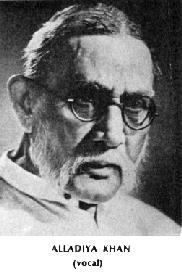
The Jaipur gharana is a dissident branch of the Agra gharana , founded by the illustrious Alladiya Khan.Adding to the fluidity and complexity of the compositions, Alladiya Khan has developped a special kind of tans, the improvised melodic phrases, totally flabbergasting and requiring exceptionnal vocal control (very few young singers try it today).
Born in Atrauli and singing at the Jaipur court, Alladiya Khan (1855-1943) made both cities famous through the gharana he founded. His training in both dhrupad and khayal genres enabled him to bring the complexities of both into his style that can be best described as filigree. The variation of note patterns serves to enhance the rendition of notes that are linked in a characteristic manner. This in no way impinges on the individual quality of the notes. The tempo is consistently slow (but not as slow as in the Kirana style), with the varying note patterns providing the rhythm.
Many feel that the gharana follows an intellectual approach, and this does not lend itself to layakari (the development and play of tempo). However, the intellectual nature of presentation in no way precludes laya. It is very much in existence through the changing pitch and volume and the note patterns themselves: these factors comprise what Deshpande terms 'functional rhythm'.
The time factor permeates every performance. The attention to every beat and half-beat is a vital feature of the Jaipur-Atrauli gharana and requires both singer and musician to co-ordinate on the sam. The sam is the most emphatic beat of the tabla (a drum) and is usually played at the beginning of the rhythm cycle and at other specific moments. The singer maintains this rhythm by coinciding the singing with the sam. In khayal singing, the sam may occur at the end of the mukhada (first melodic phrase) and the singer and musician do not consistently coincide their emphases. The Jaipur-Atraul gharana has elevated this to an art form by arriving at the emphatic beat in a specific but unexpected manner. By remaining aware of every beat and fraction of a beat even at the slow tempo, the singer can impart a great aesthetic value to the experience. Alladiya Khan was a master at this technique.
The bandishes are always the traditional ones, and no new compositions are present in the repertoire. The text itself comes second to the melodic movements and tempo of the bandish, the gharana preferring to emphasize the meaning and emotion through note combinations. Thus the musical element dominates. The akar (singing a part of the raga through the vowels 'aa') is not traditionally used (the singer Kishori Amonkar is an exception). The bols (words) are sung, and ornamented with tãns and murkis, the ornamentation being in drut laya (fast tempo). The bada khayal is sung spanning all three registers and the antara section is omitted. While vakra tãns (spiralling notes to embellish the raga) are to be found in the presentation, there is a rarity of other tãns like kanas (grace notes) and sargam tãns (sargam - a term comprised of the solfege names of the first four notes, and denoting all seven notes).
The choice of ragas reflects the school's selectivity of manner and presentation: acchob (rare) ragas and jod (compound) ragas like Sampurna-Malkauns, Basant-Kedar, Basant-Bahar, Kaunsi-Kanada and Nat-Kamod.
The concert is generally divided in two parts : the khyal features a short alap, a quick presentation of the raga, then one or two poems developed on improvised phrases; then a thumri ends the concert.
Artists
Major artists in alphabetical order
- Alladiya Khan
- Ashwini Bhide
- Arati Ankalikar
- Kesarbai Kerkar
- Kishori Amonkar
- Mallikarjun Mansur
- Mogubai Kurdikar
- Padma Tralwalkar
- Padmavati Shaligram Gokhale
- Shruti Sadolikar Katkar
- V R Kadnekar
- Vinayakrao Kulkarni
| Musical Nirvana . com | Top | Last Updated on 01-Aug-2000 |