


Medieval History - Page 3
 Medieval Period - Evolution of Hindustani and Carnatic music
The Birth of Khayal
Just like the rest of Indian musical history, there are disputes as to the origin of Khayal (also spelt as Khyal by some). Literally Khayal means Imagination in Persian. Many believe that Khayal and Qawwali were started by the legendary Amir Khusro. Some others note the closeness of the word Khayal to that of Qawwal and say Khayal originated from Qawwali. Some place the origin of Khayal to Jaunpur King, Sultan Hussein Shah Sharqi (ruled 1452-1489).
Considering most of the Khayal Gharanas were originally Dhrupad gharanas, it is safe to say Khayal originated as a leisurely form of Dhrupad with more ornamentation and improvisation, signifying a major Persian influence on this form. For khayal, the first musical evidence of court support is noted at the Delhi darbar (court) of the eighteenth century Mughal Emperor Muhammad Shah Rangile (ruled 1720-48), where the musicians Nyamat Khan with penname of Sadarang (1670-1748) and Firoz Khan with the penname of Adarang composed songs that have been transmitted to the present time. It is believed that Sadarang and Adarang also formalized the structure of modern day khayal.
Whatever be the origin of Khayal style, no doubt Dhrupad was the style that received patronage from kings and aristocracy till the time of later Mughal emperors, probably starting with Muhammad Shah. The Dhrupad compositions and style was serious and mostly in Sanskrit phraseology. Khayal compositions on the other hand were in commonly spoken language and the theme was mostly romantic. The singing style consequently was leisurely, ornamented and given to improvisation. Also, not being part of the religious ritual it was necessarily fostered outside the places of worship; hence an element of physical pleasure, particularly of the courtier, became predominant.
Further development of Khayal took place in various Gharanas, each evolving a distinctive style of singing. Each of the Gharanas have long histories and lineages which go back to early schools of music after Tansen. The gharanas had princely support in the later mogul and then British periods. Most of the Gharanas are named after the princely states that supported artists. Artists guarded their khayal compositions and musical style like heirloom passing the knowledge orally from generation to generation mostly within the family.
Another important development was the invention of numerous instruments like Tabla, Sitar, Sarod etc which changed the face of Hindustani music. Pakhavaj the percussion instrument used in Dhrupad, was probably found unsuitable as the accompaniment in Khayal. This must have given raise to the development of a more suitable percussion instrument, culminating in Tabla. The word Tabla is derived from 'Tabl', a generic Arabic term referring to any percussion instrument. Some see a connection with the Turkish term Tawal. Reference to Tabla is found from literature of 18th century, during which time it must have evolved. Various Tabla Gharana's trace their lineage also to 18th century, starting with Siddhar Khan Dhaadhi a pakhavaj player in Emperor Muhammad Shah Rangile court.
Sarod developed around mid 1800's. It probably evolved from various forms of Persian Rabab that were played in the Delhi courts over centuries. The origin of Sitar, on the other hand, is controversial. Some want to trace its origin to various Veenas found from very early days in India. Most probably Sitar evolved in 18th century out of Persian Setar (literally three strings), a string instrument used in Delhi courts from 13th century.
With the political division of the country into Persian-Muslim controlled north and Hindu controlled south, it was in inevitable that music traditions diverge. In south, the music was also bound more to the temples and religious schools than to the court, though it received ample royal patronage from three main kingdoms - Vijayanagar, Mysore and Tanjavur. Evotion traced through the development of Keerthanas of Annamacharya and Purandara Dasa, culminating in the Krithis of the trinity. Theory of music similarly evolved Vidyaranya's Sangitasara, Ramamatya's Swaramela-Kalanidhi and finally Venkatamakhin's Chaturdandi Prakashika. The bhakthi movement of Haridasas continued with the bhakthi culture of trinity and gave the philosophical basis for Carnatic music.
This is a work by Haripala Deva, the last Yadava king of Devagiri (in present day Maharashtra), written between 1309-1312 AD This is the first work where we come across the names of two main traditions of Indian Music - Hindustani and Carnatic. This has 5 sections. This work is a modification of the existing works and is a compilation of them in a concise and comprehensive way. Angabhinaya, tala, musical instruments, natya and gita are the subjects dealt with.
He explains six Veenas - Brahma veena which has only one string, Alapini, Kailasa veena, Pinaki, Akasa veena, Kinnari. This veena is of three types as Bruhat, Madhyama and Laghu and they possessed movable frets and the number of frets varied from (14) fourteen to (18) eighteen in number. It had four main strings and three secondary strings.
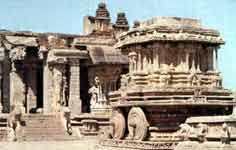
Evolution of carnatic music from the music of Ancient India can be traced to the time of the most important renaissance kingdom of the south, the Vijaynagar Empire (1336-1565). The stable and rich empire attracted artists and musicians from all over the south, especially present day south Maharashtra, Karnataka and Andhra Pradesh to its capital, present day Hampi in North Karnataka. It is probably because of this origin that the south Indian classical music in known as Karnataka Sangeetha (or Carnatic Music).
This is a major work on music by Sage Vidyaranya (1320-1380). Sage Vidyaranya, known as the founder of Karnataka, is credited with the creation of Vijayanagar empire by inspiring Hakka and Bukka. He adorned the Sharada Peetha at Sringeri. Ragas are dealt with in detail in this work. Importance of raga alaapanas and the ways of doing it are dealt with. This was the first work to classify ragas as Melas (Parent) and Janya ragas, elaborated later by Ramamatya Swaramela Kalanidhi (16th century) and Venkatamakhi (17th century). The ragas are also classified as ragas and raginis on the basis of chandas.
But it is said that the various musicians who came and settled in Vijaynagar Empire had their own ideas of how music should be sung. The mutual contradictions were so great that Vijayanagar King Achutharaya commissioned Ramaamaatya around 1550 to write a treatise reconciling the contradictions. Ramamatya wrote the Swaramela Kalanidhi. It has 5 chapters - Preface, Swaraprakarana, Veenaprakarana, Melaprakarana and Ragaprakarana. It puts in proper perspective the importance of theory as well as practice in music and assigns a proper placing for both. He explains 19 Melas and 166 Janya Raagas. He, thus, laid the foundations for the present theoretical framework. This was later expanded by Venkatamakhin into 72 Melas in his Chaturdandi Prakasika.
He has also discussed several musical instruments. The seven-stringed veena with four playing strings and three tala or rhythm strings emerged into prominence with Ramamatya who has discussed Sarwaraga mela veena. It is also said that Ramamatya constructed the modern Vina and evolved the technique of Vina playing involving both plectral technique as well as a manipulation of the strings by the fingers of the left hand
Evolution Of Carnatic Music
Haripala Deva's Sangita Sudhakara (1309-1312 AD)
Vijayanagar Empire (1336-1565 AD)
Sage Vidyaranya's Sangitasara (1320-1380 AD)
Ramamatya's Swaramela-Kalanidhi (1550 AD)
 Medeival History - Pg 2
 Medeival History - Pg 4
| Musical Nirvana . com | Top | Last Updated on 21-Feb-03 |