


Medieval History - Page 4

 Medieval Period - Evolution of Hindustani and Carnatic music
Birth of Keerthana - Tallapaka Annamacharya (1408-1503)
Tallapaka Annamacharya was the earliest known South Indian musician to compose songs called sankeertanas, what we call Keerthana, from which the modern Krithi form has evolved. He lived and composed all his work in the important pilgrimage center of Tirupathi Temple. He composed a great number of sankeertanas, about 32,000 mainly in Telugu and Sanskrit and a number of other works. But his work was lost and not found till 1922. Untill then, Annamacharya's life and work was known only through a rhyming couplet of poems called dwipada written by Tallapaka Chinnanna, grandson of Annamacharya. Chinnanna writes that Purandara Dasa visited him in Tirupathi, even though the age difference is 70 years. Anyway, it is possible that Keerthanas of Purandara were influenced by Annamacharya's work, but since the work was lost, his work did not directly influence the development of Carnatic music.
Annamacharya wrote the sankeertanas on palm leaves and later his son Tirumalacharya got them engraved on copper plates. But for reasons not known, most of these copper plates lay hidden in a rock built cell opposite to Hundi in the Tirumala temple in Tirupathi unnoticed for over 400 years. In 1922, twenty five hundred copper plates, comprising of about 14,000 sankeertanas and a few other works, were found in a rock built cell, later named as Sankirtana Bhandagaram.
The greatest impact to the musical system of the day came from the HariDasas, who were Vaishnavi saints and had an elaborate system of Guru-Shishya ashrams called Dasa Koota. The most prominent among them was Purandaradasa (1480-1565), known as the PrePitamaha of Carnatic music.
He devised the initial lessons and prescribed the graded exercises like sarali varisais, janta swaras, hetchu sthayi swaras, alankaras, geethas and so on. A person following this regimen was guaranteed to become a competent musician. Besides, Purandara Dasa pioneered many other practices. For the first time he started commenting in his songs on the daily life of the people. He incorporated in his songs popular folk language and introduced folk ragas in the mainstream. The most important contribution he made was the fusion of bhava, raga and laya into organic units. He was a great composer and thousands of his krithis are available even today. This was probably the beginning of a krithi based classical music that Karnatic music is today (one of the distinguishing characters compared to Hindustani). Dasakoota followed and orally transmitted the system devised by Purandara and also his krithis. Even today the system followed for learning Carnatic music probably is the same one devised by Purandara and faithfully transmitted by Dasakoota.
Wodeyar rulers of Mysore (1399-1947) acted as the governors in the of Mysore area with headquarters at Srirangapatna during Vijaynagar empire. After the destruction of Vijaynagar empire, they proclaimed independence and established their own powerful kingdom and ruled till Independence in 1947. With the defeat and destruction of Vijaynagar empire in 1565 at the hands of Deccan muslim rulers, artists and scholars fled south. Wodeyars and the Naik rulers of Thanjavur gave refuge and encouragement to these artists in later years.
Mysore Wodeyars were great patrons of art, music and dance. They invited musicians from all over the country and both Hindustani and Carnatic artists were made court musicians. Many of the Wodeyars themselves were well versed in music and wrote several krithis - from Chikkadevaraja Wodeyar (1673 to 1704) to the last king Jayachamaraja Wodeyar.
Telugu Nayaka rulers acted as the governors in the present day Tamil Nadu area with headquarters at Tanjavur (1530-1674) and Madurai (1530-1781) during Vijaynagar empire. After the collapse of Vijaynagar, Tanjavur Nayakas became independent ruled for the next 150 years until they were replaced by Maratha kings. The Madurai Nayakas continued to rule till Madurai slipped into the hands of British in 1781. Most of the Telugu artists and scholars in the Vijaynagar empire moved south and were patronized by the Nayakas.
Carnatic music flourished during this time and numerous composers and musicologists were patronized by the kings. The most important of them was Venkatamakhin (Venkateswara Dikshita), a musician, composer and most importantly musicologist. He was the son of Govinda Dikshitar, a great scholar, administrator and musicologist, who was a Minister in the kingdom of Tanjavur.
He wrote his most important work Chaturdandi Prakasika (AD 1635) in sanskrit. From the time of Ratnakara Music is thought to have four aspects - alaap, hasya, prabandha and geetha. Chaturdandi is the collective name for these four aspects. In this he classified Raagas into 72 MelaKartha or Janaka (parent) Raagas. Modern Carnatic classification comes from this treatise. His grandson Muddu Venkatamakhi gave final shape to the Melakartha scheme and gave a name for all of them. It is believed that Muddu Venkatamakhi passed on the 72 Melas to the father of Muthuswami Dikshitar. The trinity strictly followed the Melakartha scheme. The 72 Melas included Asamporna Ragas i.e. those which did not have full seven notes. Later musicologist Govindacharya modified the scheme to contain only Sampoorna Raagas and that is the scheme in use today.
Maratha kings (1674-1947) who succeeded Nayakas at Tanjavur continued the patronage of music and arts and Tanjavur became one of the great centers for music. It was during this Tanjore Maratha period that the famous Carnatic Trinity revolutionized Carnatic music.
The trinity of Thyagaraja(1767-1847), Muthuswami Dikshitar(1776-1835) and Syama Shastri (1762-1827) were contemporary composers. They were never directly patronized by any royal court but were attached to temples of Vaishnava cult. Muthuswami Dikshitar composed most of his krithis in Sanskrit, while the others worked in Telugu. They were probably of Telugu origin or could have composed in Telugu because it was the prevalent language for literature at the time.
The main contribution of the trinity was the standardization of kriti format as the most important form of Carnatic music. Starting in the 16th century, composers like Muthu Tandavar and Margadarsi Sesha Ayyangar had experimented with the kriti format and the characteristic pallavi-anupallavi-charana structure, one that was followed in Kshetragna's padas. The trinity, particularly, Tyagaraja perfected this format with the result that it dominates Carnatic music today. Thus, unlike Purandaradasa and musicians of his generation, who had perhaps a couple of dozen ragas to work with, Tyagaraja experimented with hundreds thanks to the Melakartha scheme. The 700 odd known krithis of Tyagaraja feature 212 ragas; 121 of these ragas have only one composition in them. Like the Haridasas (Purandara et al), disciples of Trinity carried forward the great musical tradition and popularized their compositions. This was also the time, music came to be associated more with the temples than the courts. It took a very religious and pious color, making it highly acceptable in larger society (unlike in North India).
By 1850 AD the evolution of Carnatic music system was complete. PurandaraDasa had given the teaching system and krithis with the background of philosophy and Bhakthi. The Raaga classification and system was perfected with Venkatamakhi's Melakartha system. The trinity had given a great number of krithis in a large number of Raagas.
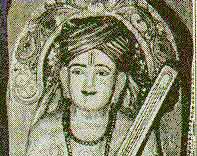
Karnataka Sangita PraPitamaha Shri Purandara (1480-1565 AD)
Mysore Wodeyars (1399-1947 AD)
Telugu and Maratha Kings of Tamil Nadu
Venkatamakhin's Chaturdandi Prakasika
The Trinity - Thyagaraja, Dikshitar, Syama Shastri
 Medeival History - Pg 3
 The British Raj
| Musical Nirvana . com | Top | Last Updated on 21-Feb-03 |