


Post Independence History - Page 6
 The Post Independence
Claronet
Clarinet is a wood-wind instrument of European origin. But it was found suitable for playing Carnatic music too. It is played like the Nadaswaram (Nagaswaram). In the 19th century itself Mahadeva Nattuvanar was the first to practise this instrument and introduce it in a dance band in South India. But Clarinet was made popular on the concert stage mainly by 'Clarinet Chakravarthi' A.K.C. Natarajan, who adopted it very well to the needs of carnatic music - raga alaapanas and vocalized techniques.
Saxaphone
Saxophone though, is a recent introduction. The credit goes to Kadri Gopalnath, who began training in nagaswara from an early age. But he was thrilled by the vibrant tone of the saxophone played by the Mysore Palace Bandset and decided to master it. It took 20 years for Kadri to conquer the complex wind instrument. Since the 80s, he has become a regular on Carnatic concert stage, successfully adapting Saxophone to the demands of Gamakas of Carnatic music.
Mandolin
Mandolin was introduced to Carnatic music by the famous child prodigy U.Srinivas. Mandolin is a small instrument which was developed in Italy from existing lutes. It has 4 pairs of strings. It was modified in the 50s to have 4 single strings and the electric block mandolin was born. Mandolin is inadequate to play Carnatic music. Srinivas introduced a fifth string (to the tradition 4 string electric block mandolin), used single strings instead of using pairs of strings. He also tuned the strings differently to get the strings to the right pitch. he devised very ingenious fingering techniques for playing intricate 'gamaka's. All this enabled him to successfully adapt Mandolin to Carnatic music.
Child prodigies always have a magnetic attraction on the concert circuit. Srinivas had become a celebrated concert artist even as he was just entering teenage in the 80s. As with other new instruments, success of mandolin as an established carnatic instrument can only be gauged in the coming decades.
Starting with 70s, the introduction of cheap cassettes and cassette players had another effect. A completely new genre of music was available to the youth as a form of entertainment - the Western Music, mostly of Pop and Soft rock varieties. Increasingly, the middle class youth stopped listening to Indian music and took to western music in a big way. With middle class being the primary patrons of classical music in the post independence period, this meant that slowly classical music would fade away due to lack of listeners. A lot of artists and classical music enthusiasts got worried about this new development.
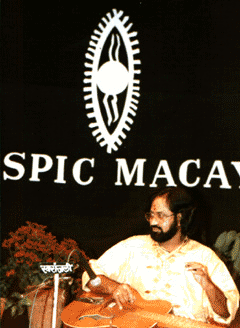
One of the organizations which came up to combat this trend was SPICMACAY. It was started by Prof. Kiran Seth (IIT Delhi). When Kiran Seth was studying in US, he was attracted by a chance listening to a Dhrupad concert. He reasoned that if enough college students were exposed to classical music, many of them would be attracted to it. He started the Society for the Promotion of Indian Classical Music And Culture Amongst Youth in 1977, in Delhi. The purpose was to organize concerts of the very best artists in various colleges around the country so that the youth could experience the very best of Indian Music for free. The money would be raised from Govt and private companies. Many chapters and sub-chapters opened all over India in various cities and colleges. The central SPICMACAY paid for the artists and their travel. The local chapters would raise the money for actual conduct of the concert. Most of the top artists agreed to participate in this effort at meagre remuneration. SPICMACAY during the 80's expanded at a furious pace, organizing hundreds of concerts and LecDems (lecture demonstration) every year.
In the 90's SPICMACAY has expanded to include a lot of smaller towns as well. Apart from Colleges, many schools now have SPICMACAY chapters. Many of the foreign universities too have their own chapters. Apart from Indian Classical music, SPICMACAY also promotes other aspects of culture - Dance, folk arts, Yoga etc.
Westernization and SPICMACAY
 Post Independence Pg 5
 Introduction
| Musical Nirvana . com | Top | Last Updated on 21-Feb-03 |